Skip to content
INDUSTRIES

Industry software built around how your operations actually run.

Off-the-shelf platforms make you change your process to fit their assumptions. We do the opposite: map how your business actually works, then build systems around it. The more moving parts you have, the more that distinction is worth.

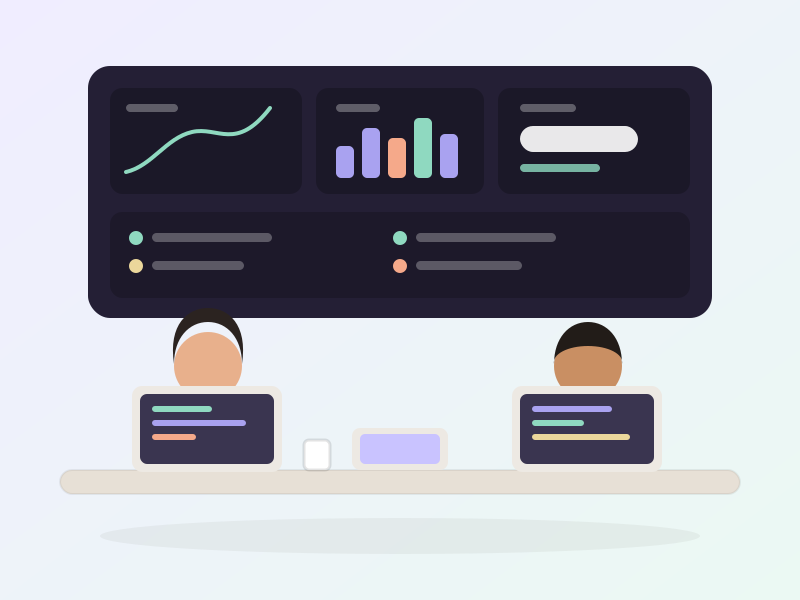
An operations floor with staff tracking live throughput

We build for businesses where operations are the hard part.

We’re most useful when the process itself is the complexity.

Our work concentrates in six sectors, and they have more in common than they look. Each one runs on multi-step workflows, physical or regulatory constraints, and data that has to be correct rather than approximately right. In every one of them, the gap between what the software does and what the business does gets paid for in manual work.

That’s the pattern we build against. A missed stock count in manufacturing, a mis-scanned parcel in logistics, and a duplicated patient record in healthcare are the same class of problem: a system that doesn’t reflect the real process, absorbed by someone’s spreadsheet.

We’re less useful to businesses whose operations are simple and whose main constraint is marketing.

Where we work.

Manufacturing & Distribution

THE PROBLEM WE USUALLY FIND

Production planning in one spreadsheet, stock levels in another, and a gap between them that only becomes visible when an order can’t be fulfilled. Purchasing decisions made on numbers that were accurate last Tuesday.

WHAT WE BUILD
  • Custom ERP with production planning, BOM management and work-order tracking
  • Real-time inventory across multiple warehouses and locations
  • Barcode and QR scanning for goods-in, movement and dispatch
  • Supplier portals with automated purchase orders and reorder thresholds
  • Machine and line utilisation dashboards
  • Demand forecasting from historical production and sales data

A production and distribution floor with racking and pallets
OUTCOME TO AIM FOR

One live number for stock, one for capacity, and a purchasing process that doesn’t depend on someone remembering.

→ Manufacturing Solutions

Retail & E-commerce

THE PROBLEM WE USUALLY FIND

A storefront on a template platform that slows down as the catalogue grows, inventory that doesn’t reconcile between online and physical channels, and a checkout losing conversions to load time nobody has measured properly.

WHAT WE BUILD
  • Headless commerce storefronts with server-side rendering and sub-second product pages
  • Unified inventory across online, marketplace and in-store channels
  • Order orchestration, fulfilment routing and returns workflows
  • Customer data platforms combining behaviour, purchase history and support contacts
  • Demand forecasting and automated replenishment
  • Conversion rate optimisation grounded in behavioural research, not opinion
A retail storefront running on mobile
OUTCOME TO AIM FOR

A storefront that stays fast at ten thousand SKUs and stock figures you can sell against with confidence.

→ Retail & E-commerce Solutions

Healthcare & Diagnostics

THE PROBLEM WE USUALLY FIND

Patient information split across a booking system, a lab platform and a records system that don’t share a patient ID — so staff re-enter the same data three times, and every re-entry is a chance to get it wrong.

WHAT WE BUILD
  • Patient management and scheduling systems with a single patient identity
  • Diagnostic and lab workflow platforms with result routing
  • Compliance-aware data handling: encryption at rest and in transit, audit logging, role-based access
  • Clinician and patient portals
  • Integrations with existing EMR, lab and imaging systems
  • Operational dashboards for capacity, throughput and turnaround times
A diagnostics lab with clinician reviewing patient records
OUTCOME TO AIM FOR

One patient record, one audit trail, and staff spending their time on care instead of transcription.

Compliance requirements — HIPAA, GDPR, local health data regulation — are defined during discovery and designed into the architecture, not added afterwards.

→ Healthcare Solutions

Logistics & Supply Chain

THE PROBLEM WE USUALLY FIND

Customers calling to ask where their shipment is, because the answer lives in a driver’s head or a WhatsApp message rather than a system. Route planning done by experience because there’s no data to plan with.

WHAT WE BUILD
  • Fleet and consignment tracking with live status updates
  • Route optimisation using historical delivery, traffic and load data
  • Warehouse management: bin locations, pick paths, dispatch scanning
  • Driver mobile apps with offline sync for areas without signal
  • Partner and customer APIs for automated status exchange
  • Proof-of-delivery capture with photo, signature and geolocation
A logistics depot yard with vehicles and live route tracking
OUTCOME TO AIM FOR

Every consignment traceable without a phone call, and route decisions made on data rather than instinct.

→ Logistics Solutions

Finance & Fintech

THE PROBLEM WE USUALLY FIND

Fast-moving product requirements sitting on infrastructure that can’t demonstrate who did what, when. Compliance handled by process discipline rather than by the system, which works until it doesn’t.

WHAT WE BUILD
  • Secure customer portals with multi-factor authentication and granular permissions
  • Immutable audit trails on every transaction and record change
  • Payment gateway, banking and KYC provider integrations
  • Automated reconciliation and reporting
  • Risk scoring and fraud detection using predictive models
  • Role-based access control designed around segregation of duties
A fintech trading desk with secure portals and audit trails
OUTCOME TO AIM FOR

A platform where compliance is a property of the architecture rather than a quarterly scramble.

→ Fintech Solutions

SaaS & Technology

THE PROBLEM WE USUALLY FIND

An MVP that proved the market and now can’t carry it. Onboarding a customer takes an engineer. Billing is half-manual. Every new enterprise prospect asks for SSO, audit logs or data residency that the original architecture can’t support.

WHAT WE BUILD
  • Multi-tenant architecture with proper data isolation between customers
  • Automated subscription billing, usage metering, trials, upgrades and dunning
  • Role-based access control and team management
  • Public API and developer documentation for integration partners
  • Admin tooling so support and success teams can resolve issues without engineering
  • Infrastructure that scales with usage rather than being rebuilt at each threshold
A SaaS product team planning a roadmap
OUTCOME TO AIM FOR

Onboarding a new tenant is a configuration change, and the enterprise checklist stops being a blocker.

→ SaaS Solutions

“Have you worked in our exact industry?”

Sometimes yes, sometimes no — and we’ll tell you honestly which. But the question matters less than it seems, because the technical problems repeat across sectors even when the vocabulary doesn’t.

Multi-location inventory in manufacturing is the same architecture as multi-warehouse stock in retail. A diagnostic result routing through approval stages is structurally identical to a claim moving through underwriting. Offline sync for a delivery driver in a rural area is the same problem as offline sync for a technician in a basement plant room.

What genuinely doesn’t transfer is domain knowledge — your regulations, your terminology, your edge cases, the reason a particular step exists that looks redundant but isn’t. That’s why discovery is built around talking to the people who do the work.

Architecture patterns transfer.

Most operational problems are a handful of well-understood technical shapes wearing different vocabulary.

Domain knowledge is yours.

We extract it in discovery instead of pretending we already have it.

We say no when we should.

If a sector’s regulatory burden is outside what we can responsibly take on, we’ll tell you rather than learn on your budget.

Common questions about sector experience.

We’re not in any of these six industries. Can you still help?+

Usually yes. These are where our work concentrates, not a restriction. If your business runs on complex operational workflows, the underlying engineering is familiar territory. Discovery will tell us both quickly whether it’s a fit.

Can you integrate with the industry platform we already use?+

If it has an API, almost certainly. If it doesn’t, there are usually other routes — database-level integration, scheduled exports, or middleware. We check this specifically during discovery, before anything is promised.

Do you handle regulatory compliance?+

We build to the compliance requirements defined in discovery — encryption, audit logging, access control, data residency, retention rules. We’re engineers, not your compliance advisors: you or your legal team define what applies, and we make sure the architecture satisfies it and can prove it.

Can we see work you’ve done in our sector?+

Yes, where the client has agreed to be referenced. Where they haven’t, we can walk through the architecture and the outcome without naming them. Ask on the call and we’ll show you what’s relevant.

We have one very unusual process. Will custom software actually handle it?+

That’s generally the strongest argument for custom rather than against it. Unusual processes are exactly where off-the-shelf platforms force expensive workarounds. What we need to establish in discovery is whether the process should be automated as-is or simplified first.

Tell us how your operation actually works.

Bring the process that’s costing you the most manual hours. Thirty minutes with an engineer, no deck, and an honest read on whether software is the right fix — or whether the process needs changing before anyone builds anything.